Mar 26, 2026
Tissue Embedding Station: Complete Guide for Histopathology Labs
The tissue embedding station is the key transition point in the path between a clinical biopsy and a definitive diagnosis. As the tissue processor processes the chemistry of the sample, the embedding station shapes the physical structure of the sample. Even the state-of-the-art microtome cannot create the paper-thin sections needed by a pathologist to examine under a microscope without a high-quality paraffin block.
Given its significance, several problems arise repeatedly and have been noted to still occur in several histopathology laboratories: the quality of embedding, the temperature of paraffin, and mechanical breakdowns that result in brittle or lumpy blocks. They are not just technical inconveniences, but they are threats to the integrity of diagnosis. An efficient tissue embedding station is essential to producing quality tissue sections and delivering the lab within its Turnaround Time (TAT) threshold.
Here, we explore the inner details of the operation of these stations, the most frequent pitfalls that can spoil your results, and the role of professional calibration in ensuring that your lab is at the forefront of precision medicine.
What is a Tissue Embedding Station?
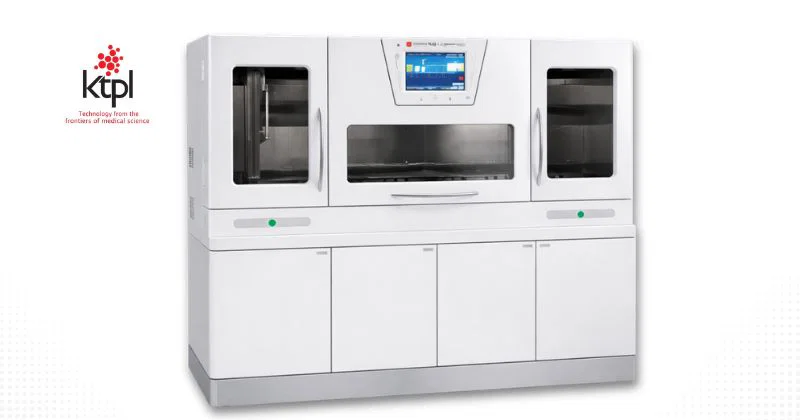
A tissue embedding station is a specialized work station in the laboratory that is used in order to enclose the processed tissue with molten paraffin wax. When the wax is cooled and solidified, it forms a stable and hard block holding the tissue in the necessary position.
This station is used in research labs and exclusively in histopathology laboratories and is basically the moulding centre of the laboratory. It enables technicians to take delicate, processed specimens and convert them to robust samples that can be stored over a long period and sectioned with extreme accuracy.
How a Tissue Embedding Station Works
It might sound simple and that is because there should be a balancing act of time and temperature. The quality of sections and diagnosis are both directly influenced by each stage of the tissue embedding station.
1. Paraffin Heating
The station has to maintain a constant temperature of paraffin wax- 55 °C to 62 o C. When the wax is not hot enough, it may cook and burn the tissue; when it is too cold, it may harden too soon, leaving gaps or bubbles.
2. Tissue Orientation
This part is the most human part of the process. The technician uses a metal mold to put the tissue. The orientation is essential; an example of the orientation is a tubular structure, such as an arteries should be oriented in a way that the pathologist can observe a cross-section.
3. Embedding Process
The heated reservoir forces the molten paraffin through the tissue mold. This is followed by placing a plastic cassette on the top of the mold, which serves as the handle to the microtome in the future.
4. Cooling Stage (The Cold Plate)
The shape is applied to a chilled plate of refrigeration. Quick and uniform cooling makes sure that the paraffin crystallizes properly around the tissue, forming an even block with no cracks.
Types of Tissue Embedding Stations
Based on the volume and infrastructure of your lab, you can use various configurations:
- Manual Embedding Stations: These consist of modular systems in which the mold is passed through a paraffin dispenser, a thermal console, and a separate cold plate by the technician. They are affordable, but they depend on the speed and the expertise of the operator a lot.
- Automated/Integrated Embedding Systems: These are systems that integrate the paraffin dispenser, heated storage of the molds/cassettes, and cooling plate into one ergonomically designed work station. They are more consistent and have a significantly faster workflow.
- Embedding Station with High-Power Cold Plate: Dedicated units of high-throughput laboratories that demand solidification speed to meet hundreds of blocks per shift, which provides a tremendous increase in sample quality and throughput.
Common Problems in Tissue Embedding Stations
Hours of processing may be spoiled with even small mechanical drifts. Common issues include:
- Incorrect Orientation of Tissues: It results in lost diagnostic characteristics of a section.
- Varying Wax Temperatures: Will produce paraffin that is either too brittle or too soft.
- Air Bubbles in Blocks: These result in the tissue crumbling as it is introduced to the microtome blade.
- Malfunctioning of equipment: Failure of heating elements or cooling compressors during a shift.
- Calibration: If there is no accurate sensor calibration, the temperature that is shown on the display is not necessarily the same temperature as the actual temperature.
The Risk: Minimal errors during embedding may result in ineffective sectioning and demand that the lab re-embed the tissue, which wastes time and can also cause harm to the specimen.
Importance of Calibration & Maintenance
NABL/ NABH compliance requires that your embedding station be regularly validated. Accuracy is not compromised in three fundamental modules:
- Heating Module: To avoid thermal effects on the tissue.
- Cold Plate: To allow the freezing of crystallization of the paraffin.
- Dispenser System: To allow a free-running, unclogged flow of the wax.
Consistently scheduled Preventive Maintenance (PM), a special Annual Maintenance Contract (AMC), is the way to make sure that your equipment does not merely work, but works with the accuracy needed in the high-stakes diagnostics.
How to Improve Embedding Quality & Efficiency
- Normalized SOPs: Have the same cooling times and orientation procedures used by every technician.
- Adequate Training of the Staff: Concentrate on anatomical orientation so that the appropriate section is put on to be sectioned.
- Close Temperature Regulation: Measure the paraffin store daily with a calibrated external temperature meter.
- Routine Calibration: Have your equipment certified by professionals like KTPL on an annual basis.
- Frequent Cleaning: Make sure that the dispenser nozzle and working surfaces are not full of excess wax.
Why Outsource Calibration & Maintenance?
The most effective method of achieving audit preparedness is to outsource to an independent biomedical service provider. Expert servicing offers:
- Cost-Effectiveness: Preventive care will avert the necessity of such costly component replacement.
- Professional Service: Engineers who know the peculiarities of different brands and models.
- Less Downtime: Fast response time means you won’t have to hold up on your lab due to the freezing of one of your dispensers or a hot or cold plate.
How KTPL Supports Tissue Embedding Stations
At KTPL, we understand that the embedding station is the key point of the productivity of your lab. The way we guarantee your equipment is by providing you with consistency and reliability, which is:
- NABL-Compliant Calibration: a young test of thermal zone precision to meet international standards.
- AMC and Preventive maintenance: A complete service schedule to ensure that your station operates 24 hours a day, 5 days a week.
- Biomedical Equipment Management: Professional management of all your pathology departments.
- Refurbished Equipment Supply: Availability of high-quality, reliable embedding stations, with only a fraction of the price of new units.
Benefits of an Optimized Embedding Station
- Enhanced Tissue Quality: Easily-cut blocks which produce flawless ribbons.
- Precise Diagnosis: Pathologists are provided with the slide containing distinct and uncrushed cellular architecture.
- Reduced Re-embeds: Reduced re-embeds translate to quicker reports.
- Less Rework: Save time and reagents, and technician time.
Frequently Asked Questions (FAQs)
Q1. What do we mean by a tissue embedding station?
Ans: A workstation in the laboratory that is used to pour molten paraffin wax over processed tissue in a mold to form a solid block that can be cut into thin slices.
Q2. How does embedding work?
Ans: Processed tissue is placed in a mold, with molten wax in a dispenser, and a cassette is placed over the top, and allowed to cool on a refrigerated plate to form a solid block.
Q3. What is the need for calibration in the case of embedding stations?
Ans: With incorrect temperature sensors, the paraffin can be too hot (harming tissue), or it can not be cooled correctly (creates hard blocks). NABL and NABH audits also require calibration.
Conclusion
The embedding stage is the point at which science collides with craft. An adequately kept
tissue embedding station is a requirement to make accurate and trustworthy histopathology results that clinicians and patients rely on. It is by focusing on the performance of its equipment and maintaining it professionally that you can be sure that every block that your lab is making is a masterpiece of accuracy.
Improve Your Embedding Station Performance Today
High and low temperatures and mechanical problems do not slow down your lab.
- Make sure that it is accurate and complies with a NABL-compliant calibration.
- Minimize downtime by proactive AMC services.
- Increase Laboratory productivity through professional medical aid.
 +91-11-43523125
  mktg@ktplmedical.com