Mar 26, 2026
Tissue Processing System: Complete Guide
The fact that a modern diagnostic laboratory is operating in a high-pressure environment means that there is no margin of error. A rigorous physical and chemical change must be done on a physical and chemical sample before a pathologist is able to diagnose a disease under a microscope. The tissue processing system is the dedicated equipment that performs this process, the one that converts a raw biopsy into a slide that can be used to make a diagnosis.
With the growing workloads and a need to have faster turnaround times, the shift towards high-throughput, automated tissue processors has become a necessity. These systems guarantee that cellular morphology is preserved with absolute consistency to give the "ground truth" to make life-saving medical decisions.
What is a Tissue Processing System?
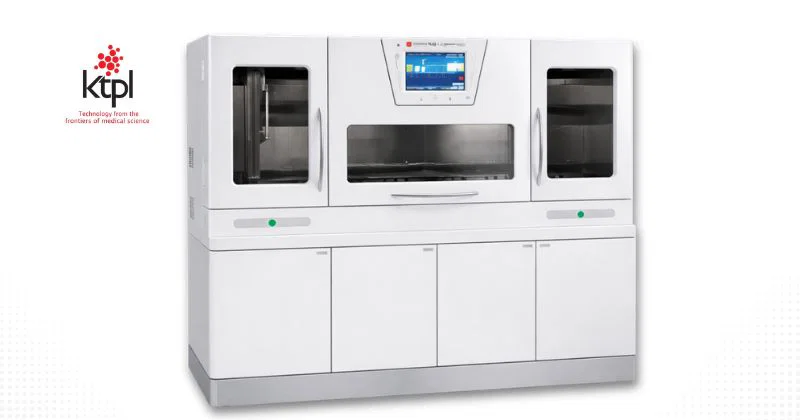
A tissue processing system is an advanced laboratory equipment that is designed to extract the water of biological samples and to substitute it with a supportive medium, commonly paraffin wax. This process causes the tissue to be rigid enough to be sliced into very thin slices (microtomy) and still remain stable.
The basic objective is identical, no matter whether it is a small tissue processing machine in a research clinic or a high-capacity automated tissue processor in a large hospital: the basic goal is to stabilize the internal structure of the tissue and retain its microscopic details.
Role in Histopathology
In the field of histopathology, tissue processing system reliability is the top priority. When a tissue has been under-processed, the tissue turns mushy and cannot be cut; when over-processed, the tissue becomes brittle and shatters.
The only way of making sure that the sensitive construction of cells and nuclei is not destroyed is proper processing. To a pathologist seeking the fine evidence of early-stage malignancy, the quality of processing is as important as the quality of the biopsy itself.
How a Tissue Processing System Works
The mechanism is based on a sequence of chemical reactions, and the basic steps of the mechanism are as follows:
- Fixation: Although usually started at the point of collection, the processor continues the sample preservation system protocols to "lock" proteins in place.
- Dehydration: The dehydration process of the tissue involves subjecting the specimen to a range of alcohol concentrations that gradually increase until all the water is extracted.
- Clearing: The alcohol and wax do not mix, so a "clearing agent" (such as Xylene) is used to remove the alcohol, leaving the tissue transparent.
- Paraffin Infiltration: In the last process, the paraffin infiltration system is used, in which the clearing agent is replaced by molten wax that fills all the microscopic fissures within the tissue.
Key Components of a Tissue Processing System
Contemporary specimen processing equipment is a marvel of engineering, including multiple vital modules:
- Reagent Containers: There are several stations where alcohols, clearing agents, and fixatives are kept.
- Heating Chamber: Heats the paraffin wax in a liquid form (usually around 58 0 C to 60 0 C).
- Vacuum & Pressure System: This involves using air pressure to pump reagents into the dense centres of large tissue samples, which can greatly accelerate this process.
- Control Panel: A digital control that enables the technicians to program the specific runs based on the size and type of tissue (a fast run with small biopsies and a long run with large fatty tissues).
Types of Tissue Processing Systems
The systems selected by labs are dependent on the volume and degree of precision needed:
Manual Tissue Processors
These are predominantly legacy systems, whereby an operator has to manually transfer baskets of tissue from one beaker of reagent to another. Although cost-efficient, they have high chances of human error and unstable outcomes.
Automated Tissue Processors
The industry standard. With an automated tissue processor, the tissue is held still within a single retort, and the reagents are pumped in and out. This secluded system helps in keeping the staff out of exposure to fumes that are dangerous, as well as in ensuring that each stage is properly timed.
Vacuum Tissue Processors
These machines are able to process dense samples (such as breast or bone tissue) in much less time than atmospheric processors, using a vacuum tissue processing cycle. The vacuum removes air in the tissue, enabling the reagents to enter the core more effectively.
Importance of Tissue Processing in Diagnostics
The most important aspect of defining the quality of slides is the biopsy processing system.
- Cancer Detection: The only method to detect the presence of "mitotic figures" or "nuclear pleomorphism," the hallmark of cancer.
- Genomic Testing: This modern-day system must be able to process tissue in a gentle way that will preserve the DNA and RNA required to perform downstream molecular testing.
Benefits of Using an Automated Tissue Processing System
A complete shift to automated lab systems will have an immediate ROI:
- Better Precision: Repeated agitation of reagents and regulation of temperature result in the same results.
- Less Human Error: Removes the possibility of a technician leaving a sample in alcohol too long.
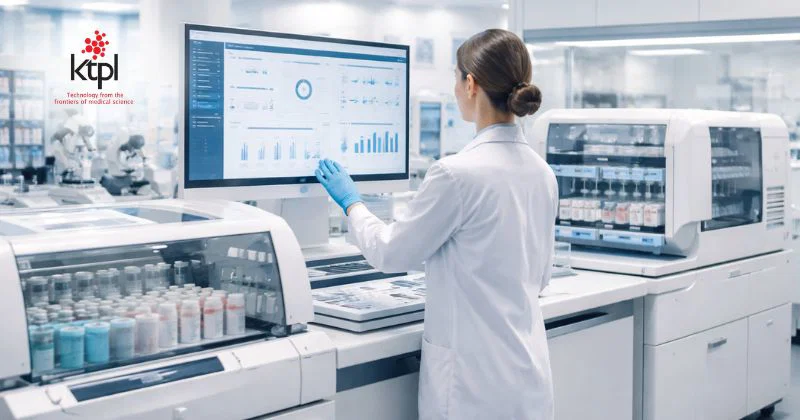
- Lab Workflow Optimization: Machines can be programmed to operate overnight, so that processed tissue is available to be embedded as soon as the morning shift arrives.
- Safety: Enclosed systems with charcoal filters help to avoid inhaling harmful Xylene and Formalin vapours.
Applications of Tissue Processing Systems
These systems are considered basic clinical laboratory equipment:
- Hospitals: To perform routine diagnostic biopsies.
- Research Laboratories: To perform drug discovery research and research on disease progression in animal models.
- Pharmaceutical Companies: Experiments on the impact of newly synthesized compounds on the structure of tissues.
- Academic Institutions: Education of the future generation of histotechnicians and pathologists.
Challenges in Tissue Processing
Despite sophisticated lab equipment in pathology, labs should be cautious of:
- Reagent Contamination: When the water is carried over into the wax, the tissue will not infiltrate properly.
- Equipment Malfunction: A malfunction of a heater can cause the wax to solidify inside the pumps thus costly repairs.
- Poor Fixation: There is no high-end processing that can rescue a sample that was not properly fixed at the beginning.
How to Choose the Right Tissue Processing System
When selecting a pathology equipment provider, consider these factors:
- Throughput: Do you have to work with 50 cassettes per day or 300?
- Reagent Management: Does the system include an automated purity check to notify you when you need to change the chemicals?
- Footprint: Does your lab area have limited space? Floor models have increased capacity, whereas benchtop models save space.
Select a reputable medical equipment supplier to be able to get reliable tissue processing systems.
Cost of Tissue Processing Systems
The prices of units of tissue processing systems differ greatly depending on the features, such as the ability to vacuum and the capacity of the cassettes.
Expert Tip: The initial investment in an automated system is higher, but in the long run, the cost per slide decreases dramatically because of a reduction in the volume of wasted reagents, as well as the amount of labor. An automated processor can often pay for itself in the first few years of operation in a high-volume lab.
Future Trends in Tissue Processing Technology
- Microwave Processing: Accelerating chemical diffusion using microwave energy, potentially reducing processing time by 12 hours to less than 1 hour.
- Digital Integration: Systems that can communicate with the Lab Information System (LIS) in order to trace the path of every cassette in real time.
- Xylene-Free Processing: Systems that use less toxic and biodegradable alternatives to conventional clearing agents are becoming a trend toward so-called Green Labs.
Conclusion: Enhancing Lab Accuracy with Advanced Systems
A tissue processing system is far more than a "wax bath"; it is a fine tool that ensures the integrity of human life. Laboratories can guarantee that all biopsies are handled with the chemical respect that they deserve by investing in the automation of their diagnostic laboratories. The processing of high-quality data today implies a quicker and more precise diagnosis of the patient tomorrow.
Today, contact us and discuss the sophisticated systems of tissue processing in your laboratory.
Frequently Asked Questions (FAQ)
Q1. Is a tissue processor allowable to operate during the day?
Ans: Yes, however, most labs have them running overnight so that they can get maximum efficiency. During the day, small biopsies can be processed by the so-called rapid processors in as little as 1 to 2 hours.
Q2. What would occur in case a sample is over-processed?
Ans: Tissues that are over-processed are extremely brittle. The tissue shatters or forms venetian blinds when the technician attempts to cut it in the microtome, and the tissue simply falls apart.
Q3. Is it only paraffin wax that can be used as an embedding medium?
Ans: The routine light microscopy standard is paraffin. But in the case of electron microscopy, the resins are used, and in very soft tissues, celloidin might be preferable.
Q4. What is the frequency of changing reagents?
Ans: This is based on the throughput (number of cassettes). In most modern systems, a counter gives a warning to the user to stop after a designated number of cycles or under a predetermined gravity check.
Q5. What is the purpose of having a vacuum in the retort?
Ans: The vacuum eliminates the air and other residual clearing agents on the tissue, allowing the heavy paraffin wax to flow into the microscopic spaces much faster.
 +91-11-43523125
  mktg@ktplmedical.com