Mar 27, 2026
Automated Slide Stainer: Complete Guide for Histopathology Labs
The distinction between a definite yes and a wary maybe is the last visual impression of a slide in the high-pressure environment of a pathology laboratory. The automated slide stainer is a high-tech device that causes this clarity. This machine allows the conversion of almost transparent tissue sections into high-contrast maps that show each cell within tissues in a way that can be confidently analyzed and interpreted by the pathologist through the careful selection of dye concentrations, most commonly Hematoxylin and Eosin (H&E).
Although the shift to digital pathology has been made, the need to have consistent staining is still there. Inconsistency of manual staining at many laboratories, human error in timing, and manual processes taking a lot of time have continued to be bottlenecks of the whole process at the laboratories. Not only are these variations aesthetic, but they can blur nuclear details or produce artifacts that would result in diagnostic latency.
A slide stainer that is automated provides improved, precise, and efficient staining outcomes. This is a detailed guide to the functionality of these systems, the available types of technology, and reasons as to why professional calibration is the sole method of ensuring the integrity of NABL-compliant results.
What is an Automated Slide Stainer?
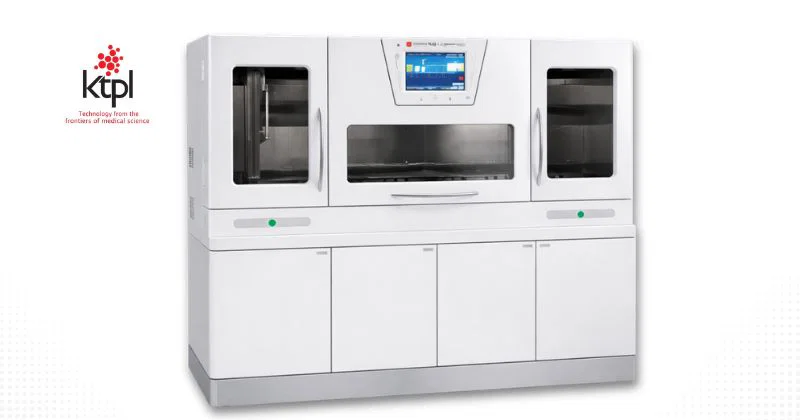
An automated slide stainer is a laboratory device that is used to automate the different processes involved in staining thin sections of biological tissues or cell smears on glass slides.
Whereas in manual staining, a technician would have to manually move the slides through various reagent jars, an automated stainer would use robotic arms or fluidic systems to step the processes through with mathematical accuracy. These machines are the workhouses of any histopathology/ cytology laboratory, making sure that all the slides, whether it is the first of the morning or the last of the night, appear exactly similar.
How an Automated Slide Stainer Works
The automation is so beautiful because it avoids tiredness in reproducing complicated protocols. Automated slide stainers are used to provide consistent staining of all samples in a 4-stage procedure:
1. Slide Loading & Batch Processing
Slides are inserted in racks or baskets. Current stainers can be loaded continuously so that a technician can initiate a new batch and have the old one being processed; this has greatly enhanced the throughput of labs.
2. Reagent Application
The machine causes the slides to be subjected to a series of reagents. The slides are placed in tanks in dip stainers or sprayed or dripped over the slides in dispense stainers. This guarantees that all the millimeters of the tissue get equal exposure to the chemical.
3. Staining Cycles (H&E or Special Stains)
The stainer is pre-programmed. In case of a normal H and E stain, it carefully controls the duration that the tissue should spend in Hematoxylin (to make cytoplasm blue) and Eosin (to make cytoplasm pink), then several other differentiation and dehydration processes.
4. Washing & Drying
The superfluous stain is washed off by using controlled buffers or water baths. Those highly developed units also have a built in drying station to ready the slides to be covered, slipped, and subjected to microscopy immediately.
Types of Automated Slide Stainers
Depending on the type of diagnostics they offer, Labs select equipment:
- Routine H&E Slide Stainers: Rapid machines that are used in the routine (bread and butter) work of the pathology lab.
- Special Stain Stainers: These departments are involved in the more complicated protocols, such as PAS, Gram, or Reticulin stain, which use different temperatures and special reagents to identify various pathogens or tissue components.
- IHC Stainers (Immunohistochemistry): This is the most advanced type. These machines work by utilizing antibodies to identify a certain protein, and thus, there should be extreme care in the regulation of temperatures and dispensing reagents to prevent the occurrence of background or noise and false negativities.
Common Problems in Slide Stainer Machines
Even the most sophisticated automated systems may drift out of control:
- Poor Reagent Staining Results: This can frequently be due to clogged nozzles of the dispensing agent or dirty tanks of the reagent.
- Reagent Carryover: In the event that the chemicals of one tank are inadvertently carried over into the next, the subsequent stains become weakened.
- Mechanical Failure: The jams of the robotic arm or the malfunction of the motors may leave slides trapped in the acid or alcohol and destroy the sample.
- Calibration Errors: In case the internal timer or temperature sensor is not accurate, then the intensity of the staining will not be constant across batches.
Diagnostic Risk: The slightest changes to the staining may influence the interpretation of the diagnosis; the pathologist is required to request a re-stain, which doubles the turnaround time.
Importance of Calibration & Maintenance
In order to be NABL or NABH compliant, your stainer simply needs to be functional, not only functional but also validated. Professional calibration is concerned with:
- Timing Control: Making sure that there is a 30-second dip is 30 seconds all the time.
- Temperature Conditions: IHC and special stains are vital, and heat is used to speed up the chemical reaction.
- Dispensing Accuracy: This ensures that the right amount of costly reagents is dispensed, less wastage.
The Sales Bridge: Preventive measure. Investing in Preventive maintenance (PM) or Annual Maintenance Contract (AMC) with KTPL will be a guarantee that these precision sensors are tested to meet certified standards, avoiding expensive diagnostic mistakes.
Benefits of Using an Automated Slide Stainer
- Consistency: Do away with the dark vs. light staining variability with manual processing.
- Fewer Manual Errors: The timer is released to the technician, where he/she can work on more complicated tasks.
- Quickest Processing: The wash and dry processes are automated, and this shortens the total turnaround time (TAT).
- Increased Lab Productivity: More throughput enables your lab to service more patients without adding to the number of people.
Why Outsource Maintenance & Calibration?
An alliance with a dedicated biomedical team, such as KTPL, will have the following unique upsides:
- Experienced Service: Our engineers are familiar with the particular mechanical and fluidic peculiarities of leading brands of a stainer.
- Less Downtime: We see worn belts or old pumps in time to prevent their failure during a high-volume shift.
- Audit Readiness: We submit the documents that are NABL-traceable to meet the tough inspection of a hospital.
Impact on Lab Performance
The last quality piece is an optimized automated slide stainer. When the calibration of this machine and its maintenance are done, your lab enjoys:
- More Rapid Turnaround Times: Slides are delivered to the pathologist's desk faster.
- Better Diagnostic Accuracy: Diagnostic accuracy is increased with high-contrast, clean slides.
- Lowered operational expenses: Thousands are saved in terms of chemical expenses in a year with accurate reagent dispensing.
Frequently Asked Questions (FAQs)
Q1. What is an automated slide stainer?
Ans: It is a laboratory device that automates the process of chemically staining tissue sections or cell smears on glass slides, resulting in the creation of uniform color and contrast to be examined under the microscope.
Q2. The operating principle of an automated slide stainer?
Ans: The machine operates on a robotic arm or fluidic pump to position the slides in a programmed sequence of reagents (such as Hematoxylin, Eosin, and alcohols) during specific periods of time.
Q3. What is the significance of the calibration of slide stainers?
Ans: Calibration will make certain that the station timings as well as the reagent temperatures are precise. The lack of proper timing may result in over-stained or under-stained slides, and it may lead to diagnostic errors and non-compliance with the NABL/NABH standards.
Conclusion
One of the most important upgrades that a lab can have is the process of moving away from manual to an automated staining process. The machine, however, is only as good as the last time it was calibrated. The automated slide stainer should be optimized to provide life-saving, high-quality, and consistent pathology results. When you leave your maintenance and calibration to KTPL, you are guaranteed clear windows on the health of the patient.
Change Your Slide Staining System today.
Don’t allow spotty staining to impact your lab or your patients.
- Make certain Correctness and calibration of NABL requirements.
- Cut down on the downtime with proactive AMC services of KTPL.
- Enhance Laboratory performance with our highly proficient biomedical solutions.
Professional calibration and maintenance of KTLA Medical.
 +91-11-43523125
  mktg@ktplmedical.com