Mar 27, 2026
Slide Coverslipping: Complete Guide for Histopathology Labs
Slide coverslipping happens to be the last, final step in the careful process of tissue preparation. It is the procedure of covering a stained specimen with a thin layer of glass or plastic to preserve it against physical damage and chemical oxidative degradation. Although this can be viewed as a mere finishing touch, the quality of the coverslipping defines the optical clarity of the slide and its sustainability during the period of storage.
This last step can be a common frustration for a lot of laboratories. Air bubbles, lack of proper distribution of mounting media, and misaligned coverslips may conceal key diagnostic features, which forces technicians to remount slides, a dangerous procedure that may harm the underlying tissue. Manual errors and equipment incompatibilities tend to cause a backlog at the very last line.
Slide coverslipping is critical in ensuring proper examination in the microscope and preservation of the slide in the long term. We discuss a step-by-step procedure, the automation direction, and the necessity of professional calibration of your coverslipper to be the clue to diagnostic accuracy in this guide.
What is Slide Coverslipping?
Slide coverslipping. This is the addition of a thin, clear cover (the coverslip) to a stained tissue section or cytological smear on a glass slide. This is accomplished with a special type of mounting material, a clear resin that is actually an adhesive and has a refractive index akin to that of glass.
The coverslip serves three primary purposes:
- Protection: It protects the specimen against dust, scratches, and fading caused by air.
- Optical Clarity: It makes the specimen flat and gives it a smooth surface through which light can be passed in order to produce a clear image under the microscope.
- Preservation: It fixes the tissue, which enables the preservation of slides to be stored over the course of years to be used in the future or in accordance with the requirements of the law.
Slide Coverslipping Process (Step-by-Step)
Every stage of slide coverslipping is a direct influence on the quality of the slides and their diagnostic accuracy. It must be a uniform approach:
1. Slide Preparation
Stained slides should first be dehydrated and cleared (with Xylene) before a coverslip can be slipped. The mounting medium will become milky with any remaining water, which will destroy the slide transparency.
2. Mounting Media Application
The amount of mounting media is important. Excessive water on the microscope stage results in the slides sticking together during storage or oozing, which can cause gunk to be deposited on the microscope stage.
3. Coverslip Placement
The coverslip is then dropped onto the slide, preferably with an angle to squeeze the air out. Depending on whether it is by means of a forceps or an automatic coverslipper, the idea is always to achieve a bubble-free, centrally placed seal.
4. Drying & Sealing
The slides should be left to dry in a flat manner. This makes sure that the mounting media becomes solid to form an airtight vacuum over the diagnostic media.
Types of Coverslipping Methods
In the end process of preparing the slide, there are two major directions that are selected by the laboratories: the classical and more tactile method or the more contemporary and fast-paced automated one. The decision normally hinges on the volume of samples that the lab receives on a daily basis, the necessity of standardized outcomes, and the requirements of the pathology team.
The two most widespread procedures in contemporary histopathology are shown below:
- Manual Coverslipping: Usually used in smaller labs or in delicate, special samples. It is very cost-sensitive to the operators, but it is very low-cost in the first place. Even the most apt technician may have a problem with uniformity during the high volume shift, resulting in different quality of slides.
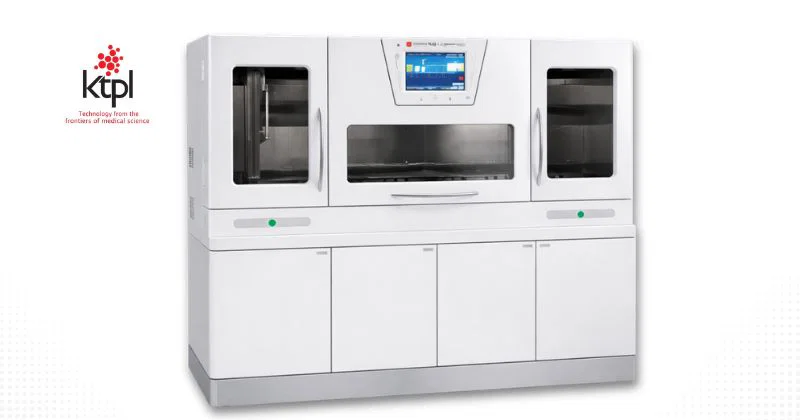
- Automated Coverslipping (Coverslipper Machines): Contemporary pathology labs use coverslipper, or combined slide mounting machines. These units are very consistent, and their workflow is much quicker. These machines can dispense and place many hundreds of slides per hour with practically no human error because of the automation of the process.
Common Problems in Slide Coverslipping
- Air Bubble Formation: The most universal problem. Bubbles are microscopically black holes concealing cells and aggravating pathologists.
- Uneven Mounting Media: Causes diverse thickness on the slide, which results in focus problems in digital scanning or high-power microscopy.
- Misaligned Coverslips: Overhanging glass can be easily broken or is able to jam automated slide scanners.
- Equipment Failure: Because it is a machine with a dried mounting media, the dispenser of an automatic coverslipper may clog up, resulting in a complete failure within the system.
- Absence of Calibration: All the slides in a batch will be affected in case the machine has incorrect settings of pressure or volume.
The Pain Line: A single mistake in coverslipping, even a small one, can taint the interpretation of the slide, resulting in diagnostic delay and lab rework.
Role of Coverslipper Machines & Automation
Coverslipping automation is no longer a luxury it is a requirement for up-to-date throughput. An automatic coverslipper is a device that enhances uniformity and increases throughput of the lab, as the entire slide is exposed to the same volume of media and the same amount of pressure during placement.
Automation is especially imperative in the era of Digital Pathology. The digital scanners demand high-resolution images and perfect, flat, clean, and aligned coverslips to obtain high-resolution images devoid of artifacts.
Importance of Calibration & Maintenance
Calibration is not an option to comply with the NABL/NABH standards of your automatic coverslipper. Maintenance must focus on:
- Dispensing System: Checking the exact volume of the microlitre of mounting media.
- Alignment Mechanism: Putting the position of coverslips within sub-millimeter tolerances.
- Suction & Transport: Monitoring the vacuum grips that are used to maneuver the delicate cells in the glass coverslips to avoid breaking them.
Sales Bridge: Proactive Preventive Maintenance (PM) and Annual Maintenance Contracts (AMC) with KTPL are the optimal solutions regarding the prevention of so-called sticky mechanical breakdowns that tend to dominate coverslipping systems.
How to Improve Coverslipping Quality & Efficiency
- Standardized SOPs: Determine the clearance time and available media volume of various types of tissues.
- Right Training: Make sure that the technicians are informed about the ability to troubleshoot the bubbles and maintain the machine dispenser.
- Controlled Environment: Humidity and temperature may have an influence on the flow and drying of mounting media.
- Periodic Checkup: Contact the local professional team, such as KTPL, to prove the mechanical correctness of your system.
- Routine Maintenance: Cleaning the dispensing needle on a daily basis is the easiest approach in preventing serious downtime.
Why Outsource Calibration & Maintenance?
By outsourcing to an expert service provider in the medical field, you can be certain that your lab will remain audit-ready without straining your personnel in the diagnostic field.
- Professional Work: Availability of engineers specializing in high-precision mounting systems.
- Less Downtime: Rapid solutions to clogged systems and sensor failures.
- Audit Readiness: The NABL-conforming documentation is mandatory in hospital accreditation.
How KTPL Supports Coverslipping Systems
At KTPL, we offer technical assistance that helps in rendering your lab output to look professional and accurate. We guarantee your coverslipping systems are providing the following reliability and quality results:
- NABL-Compliant Calibration: Dispensing and alignment module precision testing.
- AMC Maintenance-preventive: Detailed procedures to avoid mounting of media and mechanical wear.
- Biomedical Equipment Management: In the path of your whole fleet.
- Replacing Equipment Supply: Availability of well-kept high-speed automatic coverslippers at a discount on the price.
KTPL will make sure that your coverslipping systems are reliable and provide quality outcomes, so your pathologists do not have to worry about it; they can do their business, which is diagnosis.
Benefits of Optimized Coverslipping
- Improved Slide Clarity: The crisp and clear images are free of the hassle of bubbles and artifacts.
- Enhanced Diagnostic Accuracy: Optimal slides result in quicker and more certain reports.
- Lessened Rework: There is no necessity to scrape and re-mount slides.
- Reduced Lab Turnaround: Accelerate the last mile of pathology.
Frequently asked questions (FAQs)
Q1. What is slide coverslipping?
Ans: It is the act of securing a coated surface of glass or plastic (the coverslip) onto a tissue or cell sample on a microscope slide that has been stained.
Q2. How does an automatic coverslipper operate?
Ans: The machine applies mounting media and a coverslip to a slide automatically with a mechanical arm and a dispensing pump, which leads to speed and consistency unachievable by manual methods.
Q3. What is the use of the calibration of coverslippers?
Ans: Calibration is done to make sure that the machine dispenses the right level of media and that the coverslip fits on exactly. Such mistakes may cause bubbles or misplaced glass that may cause jammed, costly digital scanners and failed NABL/NABH audits.
Conclusion
The efficient slide coverslipping is the key to providing correct and dependable pathology results. It is the last protector of the integrity of the specimen. Your lab guarantees a permanent and clear record of diagnostic quality in each slide by connecting a stringent process of coverslipping with consistent equipment operation and expert calibration.
Improve Your Coverslipping Process Today
Bubbles and mechanical problems should not slacken your final results.
- Make sure that it is accurate and complies with NABL-compliant calibration.
- Minimize Malfunctions and Relapse with professional AMC services.
- Improve the efficiency of the lab using the specialized biomedical assistance of KTPL.
Maintenance and calibration expert, KTLA Medical.
 +91-11-43523125
  mktg@ktplmedical.com