Mar 27, 2026
Automated Glass Stainer: Complete Guide for Modern Pathology Labs
When it comes to patient diagnosis, in the high-stakes setting of a pathology laboratory, the visual definition of a slide is the last word. The technological workhorse, which makes sure that this word is uttered clearly every time, is the automated glass stainer. These machines have transformed pathology from a subjective art to a standardized science by automating the application of biological dyes onto tissue sections on glass slides.
Although the shift to digital pathology has taken place, the desire to have high-quality stains is not going to disappear. Lots of labs continue to deal with the variability of manual staining and manual dipping, which is time-consuming and involves human factors of reagent timing. Such inconsistencies not only impact the appearance of a slide but may also cause ambiguity in diagnosis and even expensive rework.
Automated glass stainer guarantees the same level of staining that enhances the accuracy of the diagnostic and the efficiency of the lab in general. This is a complete guide to the operation of these systems, types of systems out there, and why professional calibration is the key to laboratory excellence.
What is an Automated Glass Stainer?
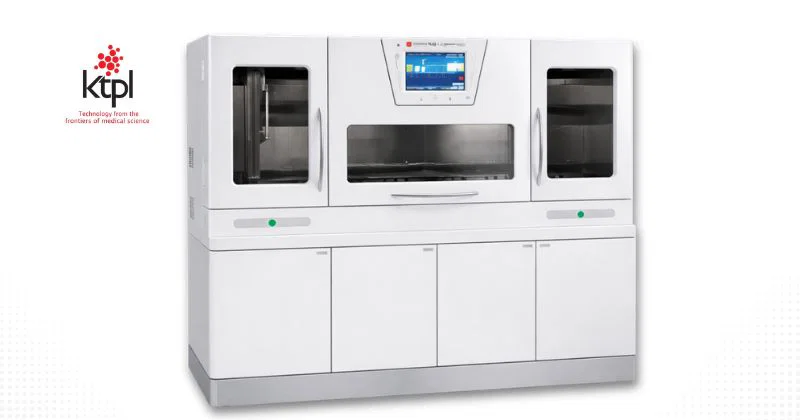
An automated glass stainer is a laboratory device to automate the different chemical procedures needed to stain biological samples on glass slides. It is either a regular biopsy or a delicate cancer screening; every single slide is handled in a mathematically accurate manner by these machines.
These systems enable the pathologists to view cellular structures using high contrast by manipulating the complex protocols of Hematoxylin and Eosin (H&E) or specialized IHC stains. To the contemporary lab, an automated stainer is the main preventive measure against the human element that tends to cause more inconsistency in the outcome.
How an Automated Glass Stainer Works
The advantage of a modern stainer is the capability to repeat complicated chemical protocols without exhaustion. The use of automated glass stainers can offer consistent and reproducible staining results by a four-step process:
1. Slide Loading & Batch Processing
Slides are loaded by technicians in baskets or racks. A majority of the modern systems also have the feature of continuous loading, which will enable the lab to work through hundreds of slides per hour without needing to press buttons to load new samples into the machine.
2. Reagent Dispensing
The machine is also accurate in the reagent application. There are systems whereby some are headed by the use of linear motion to immerse slides in tanks, and there are others whereby the reagents are sprayed using drop-on-demand technology on the glass. This makes the specimen covered in all its millimeters.
3. Automated Staining Cycles
The stainer is based on a computerized recipe. It determines the precise time of immersion of each stain e.g., Hematoxylin, which is used to stain the nucleus, and Eosin, which is used to stain the cytoplasm, so that no batch is over- or under-developed.
4. Washing & Drying
Automated wash cycles are done with excess dyes by incubating the high-pressure buffers or water, then there is a controlled drying step. This is to prepare the glass slides to be immediately covered and reviewed by the microscope.
Types of Automated Glass Stainers
- Routine H&E Stainers: The workhorse of any pathology lab, these are streamlined to be used in high volumes and are standardized.
- Special Stain Systems: Sophisticated units that are used to detect a particular pathogen (such as fungi or bacteria) or a particular tissue constituent (such as collagen or iron).
- IHC Stainers: The most sensitive system is an Immunohistochemistry system, which needs a high level of precision with regard to temperature and timing in order to detect particular proteins and biomarkers.
Common Problems in Glass Stainer Machines
Technical drift may occur even with the best automated systems unattended:
- Inconsistent Staining: This is usually due to blocked dispenser nozzles or old reagents.
- Reagent Handling Problems: There is a possibility of cross-contamination of stations, resulting in muddy colors and low contrast.
- Mechanical Failure: Leaks or mechanical robotic arm failure.
- Calibration errors: Inaccurate timers or temperature wizards that are not within the set protocol.
- Maintenance Neglect: Dried stain build-up: This impedes the mechanical motion of the slide racks.
The Diagnostic Risk: Inconsistency in staining may result in diagnostic variability and rework, which may take several days to provide treated patients with the appropriate care.
Importance of Calibration & Maintenance
In order to be NABL/NABH compliant, you cannot use a black box automated glass stainer. It must be validated. The professional calibration is concerned with:
- Reagent Dispensing System: It is important to make sure that the right amount of stain is used each time.
- Timing Controls: It is 60 seconds to make sure the immersion is 60 seconds.
- Temperature: IHC and special stains require critical conditions, and the heating rate of the chemical reaction is important.
Sales Bridge: Preventive maintenance (PM) and an active Annual Maintenance Contract (AMC) with KTPL make sure that your equipment is guaranteed to be able to meet the international standards, and this will guarantee your equipment will not suddenly fall out of service.
Benefits of Using an Automated Glass Stainer
- Stability in Staining Quality: The appearance of all the slides is similar, irrespective of the technician on shift.
- Less Human Error: Removes the potential of not following a step through a multi-step staining protocol.
- Quick Turnaround Time (TAT): Automation accelerates the final stage of slide preparation greatly.
- Greater Lab Productivity: The machine will be able to do the dipping and washing that are repetitive so that technicians can concentrate on high-level tasks.
Why Outsource Calibration & Maintenance?
To most hospitals, it is more tactical to outsource to a specialized company such as KTPL than to directly manage it.
- Cost-Effective: Any wastage of costly reagents through over-staining is avoided.
- Professional Service: Availability of engineers who are familiar with fluidic and mechanical aspects of different brands.
- Less downtime: Fast response times will guarantee that your diagnostic pipeline does not remain clogged.
- Audit Readiness: NABL-accredited certificates are received, which enable a painless process of laboratory inspections.
How KTPL Supports Glass Stainer Systems
We understand at KTPL that your stainer is the sawmill of your lab. Your automated glass stainer works well and is reliable through:
- NABL-Compliant Calibration: Accuracy of all mechanical and thermal sensors.
- AMC & Preventive Maintenance: Tailor-made programs to ensure that your stainer is operating to its full capacity 365 days a year.
- Biomedical Equipment Management: Professional management of your complete pathology instrument outlay.
- Refurbished Equipment Supply: Automated glass stainers of high quality that have been tested and are desired by a lab that wishes to upgrade, but does not have money.
KTPL will make sure that your automated glass stainer is reliable and efficient to enable your pathologists to make life-saving decisions.
Impact on Lab Performance
- Quick Diagnosis: Slides are delivered to the desk of the pathologist faster.
- Enhanced Precision: Enhanced contrast and clean backgrounds result in conclusive reports.
- Lower Costs of Operation: Less reagent waste and fewer repeats.
- Increased Conformity: NABL/NABH audit documentation is complete.
The Frequently Asked Questions (FAQs).
Q1. What is an automated glass stainer?
Ans: It is a laboratory device that is used to automate the process of staining tissue samples on glass slides with the help of chemical dyes to observe them under the microscope.
Q2. What is the mechanism of an automated glass stainer?
Ans: The machine steps the slides through a series of reagent baths (such as Hematoxylin, Eosin, and alcohols) through a robotic arm or fluidic system with controlled time and temperature steps.
Q3. What does calibration mean to glass stainers?
Ans: Calibration will be done to verify the station timers and volumes of reagents. Improper timing or temperature may result in muddy slides, wrong diagnosis, and non-adherence to NABL/NABH.
Conclusion
A high-quality and reliable automated glass stainer is necessary to supply uniform and high-quality pathology outcomes. Your lab can provide the highest level of automation with professional maintenance, so every slide to be a masterpiece of diagnostic accuracy. Your reputation should not be affected by equipment drift; invest in that kind of reliability that can only be achieved through expert calibration.
Upgrade Your Staining System Today
Mechanical error or bad staining is not to be tolerated.
- Guarantee Accuracy and NABL Compliant Calibration.
- Minimize downtime using our preemptive AMC services.
- Enhance Laboratory Productivity with the services of KTPL's expert biomedical.
Contact KTPL Medical for expert calibration & maintenance services.
 +91-11-43523125
  mktg@ktplmedical.com