Oct 04, 2025
Hospital Equipment Calibration: Ensuring Accuracy and Patient Safety
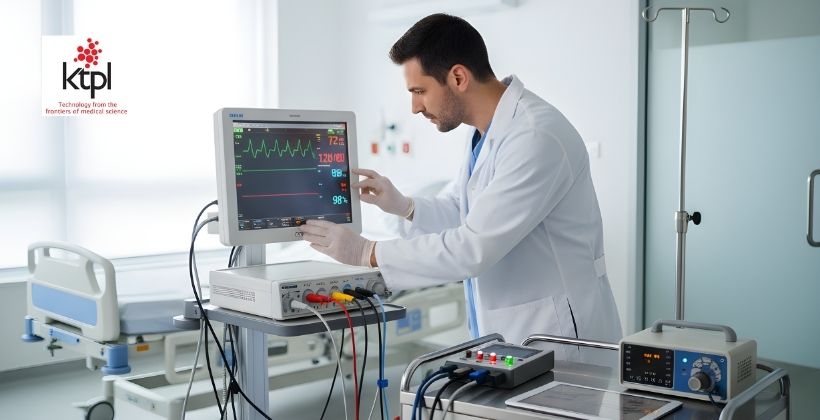
Are you sure that your hospital can trust its equipment readings 100%? The information on a screen is all in a high-pressure clinical environment that may be the difference between a successful treatment and a critical error. It is not a luxury, but a life-saving necessity that it be precise whether it is the tidal volume on a ventilator in the ICU or the heart rate rhythm on a bedside monitor. The muffled engine of health care quality is hospital equipment calibration.
It also makes certain that all diagnostic equipment and life-support systems are running within the stringent tolerances that are necessary to safeguard human existence. Within this guide, we explore the paramount importance of healthcare equipment calibration and the importance of adhering to a strict schedule as the only means of ensuring patient safety, as well as institutional compliance.
What is Hospital Equipment Calibration?
Calibration, at its most basic, is the process of ensuring that a medical device produces a result that is comparable to a known standard that can be traced. In the long run, any electronic and mechanical sensors are affected by drift because of the environment, heavy use, or aging of the component.
Hospital equipment calibration involves:
- Verification: Comparing the device and a master reference.
- Restoration: Recalibration of equipment to make it accurate to the manufacturer's requirements.
- Certification: Making a formal report that demonstrates the device is safe to use in clinical settings.
Hospitals make a shift towards proactive accuracy rather than reactive fix instead of merely repairing biomedical equipment, by converting the standard operating procedures to include the calibration of biomedical equipment.
Why Calibration is Critical in Hospitals
The life involved in a hospital is much greater than any other industry. The dangers of using uncalibrated equipment are far-reaching:
-
Diagnostic Error Prevention: An inaccurately calibrated lab analyzer or ECG may give a false baseline, which makes a false diagnosis and results in wrong medication or unnecessary surgery.
-
Hospital Safety: Hospital equipment, such as infusion pumps, should be able to administer accurate doses. Even a small error in calibration in one of the pumps results in either toxic over-medication or ineffective under-medication.
-
Legal and Regulatory Impact: Hospitals need to comply with high standards of accuracy of medical equipment to retain their operating licenses and remain not subject to devastating malpractice liability.
Types of Hospital Equipment That Require Calibration
The entire program of clinical equipment calibration should consider all departments, and especially the high-acuity areas.
- ICU Equipment Calibration: Life-support systems are the most frequently checked systems.
- Ventilator Calibration: This is important in order to make sure that oxygen concentration and pressure levels are at the required levels.
- Infusion Pump Calibration: This is critical to the administration of high- alert fluids and medications.
- Patient Monitor Calibration: It will be important to ensure that the vital signs, such as blood pressure, SpO2, and CO2 levels, are reported without latency or inaccuracy.
- ECG Machine Calibration: Myocardial infarction or arrhythmias have to be detected by accurate tracing of heart activity.
Compliance Standards for Hospital Equipment Calibration
To the healthcare regulators, unless it is certified by a recognized body, it is not accurate.
- NABL Certified Calibration Lab: When collaborating with an NABL-certified calibration lab, you will be assured that your measurements can be linked to the national and international standards.
- Calibration Standards of ISO: In particular, ISO 17025 and ISO 13485, which are the competency standards of testing laboratories and quality management standards of medical equipment.
- Hospital Compliance Standards: Compliance with JCI (Joint Commission International) or local health board standards is required to be accredited.
How Often Should Hospital Equipment Be Calibrated?
A risk-based approach determines the calibration frequency in hospitals:
-
Type of device: Life-support devices (ventilators/defibrillators) usually need a more vigorous schedule than standard thermometers.
-
Manufacturer Guidelines: This is always the first resort in providing maintenance calibration in hospitals.
-
Usage Frequency: Equipment use in areas with high turnover, such as the ER or ICU, might need to be checked quarterly, whereas less-used equipment might only need to be checked annually.
Benefits of Regular Calibration in Hospitals
In addition to safety, the operational ROI of equipment reliability in healthcare is evident:
- Accurate Diagnosis: Gives physicians additional confidence and enhances patient flow.
- Error Reduction in Diagnostics: Minimizes the need for re-testing, saving time and resources.
- Extended Service Life of Equipment: By detecting drift, the mechanical over-compensation of the hardware that results in the failure of the equipment is avoided.
On-Site vs. Lab Calibration for Hospitals
The use of logistics is one of the determining factors when selecting a calibration service provider:
- On-Site Hospital Calibration Services: This is the most favored technique for most hospitals. It reduces downtimes, avoids the possibility of damaging delicate optics during transit, and enables the biomedical team to retain equipment inside the facility.
- Lab Calibration Advantages: Only ultra-high precision diagnostic equipment is set aside in a climate controlled, dust free laboratory.
How to Choose the Right Calibration Service Provider
In choosing a hospital calibration company, seek a partner, not a vendor.
- Accreditations: Make sure they are accredited by NABL or ISO.
- Experience: They ought to have a specialized group of biomedical calibration services.
- Documentation: They should include electronic, audit-ready certificates, which explicitly indicate the pre- and post-conditions of the equipment.
Select an accredited calibration partner to have a stable healthcare performance.
Why Calibration is a Smart Investment for Hospitals
The hospital directors should consider calibration as a quality healthcare standard. It is an investment that is proactive and:
- Avoids the Expensive Mistakes: Years of calibration service can be paid with only one malpractice suit or regulatory fine.
- Ensures Compliance: Eases the procedure of conducting yearly health board audits.
- Develops Patient Trust: A hospital that is reputed to be precise in its technical skills draws more patients and the best clinical talent.
Conclusion: Accuracy in Healthcare Saves Lives
Hospital equipment Calibration in the contemporary medical arena is no longer a choice, but a prerequisite of the Do No Harm oath. Hospitals not only save the lives of their patients, but also their employees and their reputation, by making sure that all the machines, the simplest monitor and the most complicated ventilator, are correct.
Safety: Accuracy fosters trust and guarantees compliance.
Make sure that your hospital equipment is precise and in compliance; calibrate today.
Frequently Asked Questions (FAQ)
Q1. Does the hospital comply with in-house calibration?
Ans: Although simple verifications may be performed by the in-house biomedical personnel, most of the hospital compliance requirements mandate third-party, NABL-certified calibration of high-risk equipment to guarantee worldwide traceability.
Q2. What would happen in case a piece of equipment fails to calibrate?
Ans: It must be immediately tagged "Out of Service." The machine will then be repaired and should be retested with a complete medical equipment calibration before it can go back to the ward.
Q3. Should the calibration frequency of all equipment be the same?
Ans: No. ICU equipment calibration is usually more prevalent than equipment in general outpatient clinics because of the urgency of patients and the level of use.
Q4. What is the average time of on-site hospital calibration?
Ans: The on-site hospital calibration services are usually intended to be quick in order to reduce the downtime, with several apparatuses consuming between 30 and 60 minutes per unit.
 +91-11-43523125
  mktg@ktplmedical.com